
Fortinet Network Security
Most networks run their switching, Wi-Fi and firewalling as three separate systems with three consoles and three sets of credentials. Fortinet collapses them onto one operating system and one policy. Grizzly X is a Canadian reseller — tell us where the sites are and we will scope it.
Security that travels with the connection
Networking and security grew up as separate purchases. The switch vendor sold switching, the firewall vendor sold firewalling, and the seams between them became the places nobody owned — a VLAN that was never segmented, an access point trunked straight past inspection, a 5G failover link that bypassed the policy entirely.
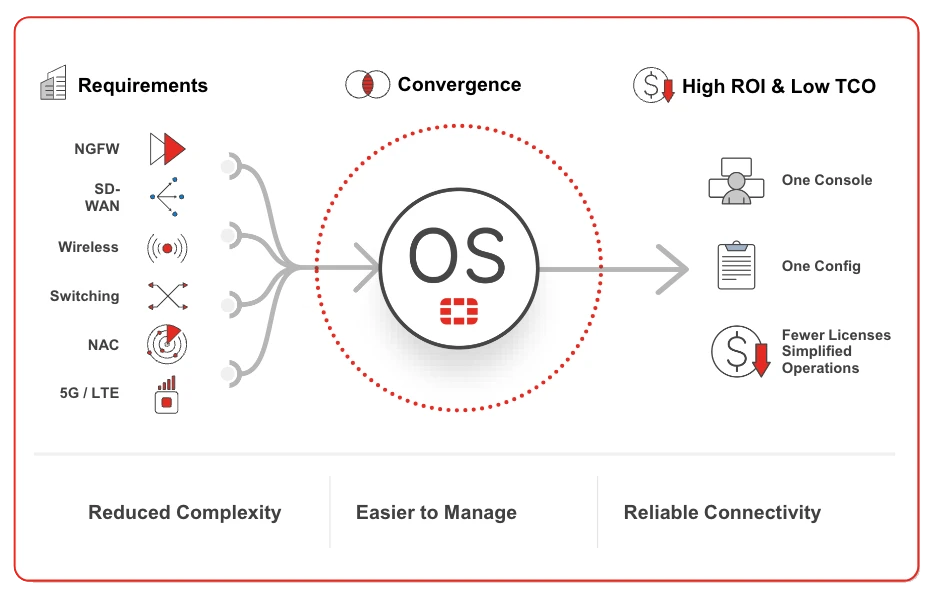
Fortinet's position is that the two should be one product. FortiOS runs the firewall, and the same FortiGate manages the switches, access points and LTE gateways behind it over FortiLink. Ports, SSIDs and tunnels become objects in the firewall policy rather than configuration in somebody else's console.
The practical test is whether adding a device adds a system. On a converged network it does not: a new switch inherits the policy that already exists, and shows up in the same logs as everything else.
Fortinet Security-Driven Networking | Network Security
What converging actually buys you
-
Better protection
The gaps between products are where incidents start. When the switch, the access point and the firewall share one policy engine and one threat feed, there is no segment that is protected by assumption rather than by a rule.
-
Lower total cost
One vendor, one support contract, one renewal date and one skill set to hire for. The saving that matters is rarely the hardware line; it is the hours that stop going into reconciling three systems that disagree.
-
Fewer things to operate
Provisioning a branch becomes a template rather than a project. FortiAIOps correlates events across the fabric, so a Wi-Fi complaint is diagnosed against the switch port and the WAN link rather than guessed at.



Where it gets deployed
Campus
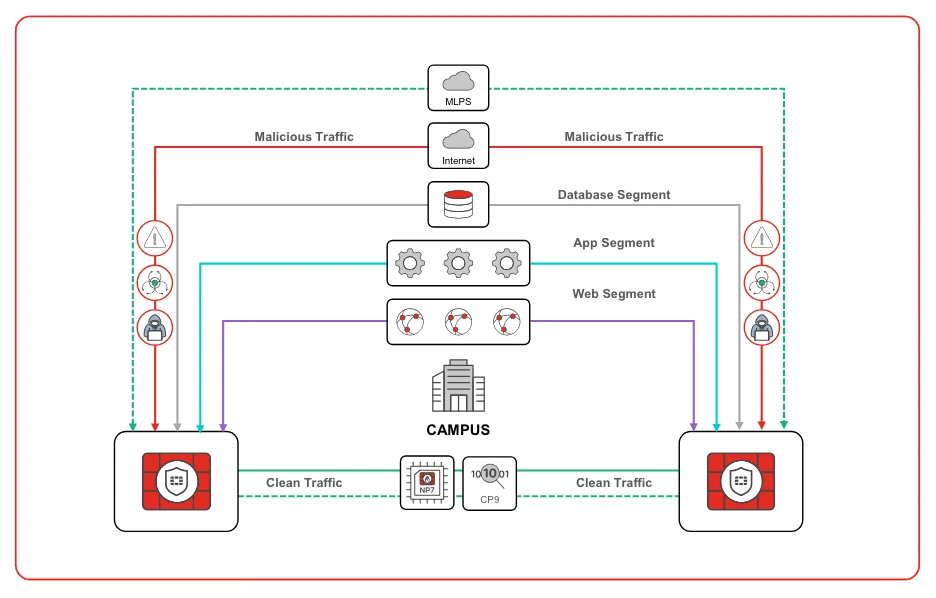
A campus has the hardest traffic problem: thousands of devices, most of them unmanaged, all on the inside. The FortiGate segments web, application and database tiers from each other and inspects what crosses between them, with the NP7 and CP9 processors doing the work so that inspection does not become the bottleneck. FortiNAC decides what a device is allowed to be before it gets an address.
Data centre
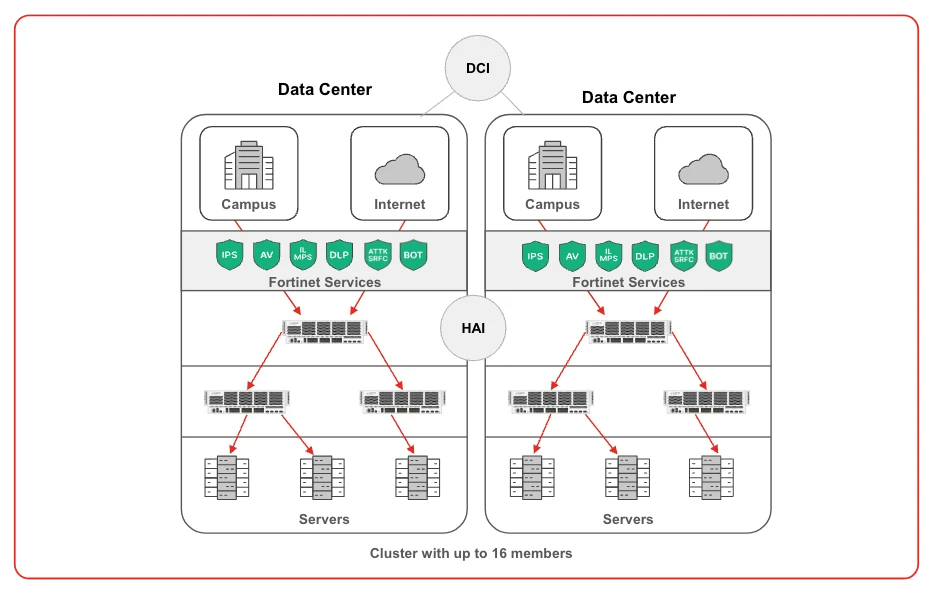
East-west traffic between workloads is the part most estates never inspected. Policy written once is replicated to every data centre firewall, physical or virtual, so a second site is a copy rather than a reinterpretation. Throughput is the constraint to design around here, which is where the higher-end appliances earn their price.
Branch
One FortiGate at a branch is the firewall, the SD-WAN edge, the switch controller and the Wi-Fi controller. Fewer boxes on site means fewer things to fail and nothing to truck-roll an engineer out for, and the branch inherits the estate's policy rather than a local approximation of it. FortiExtender adds 5G or LTE as a real WAN link rather than a bypass.
Secure NOC at scale
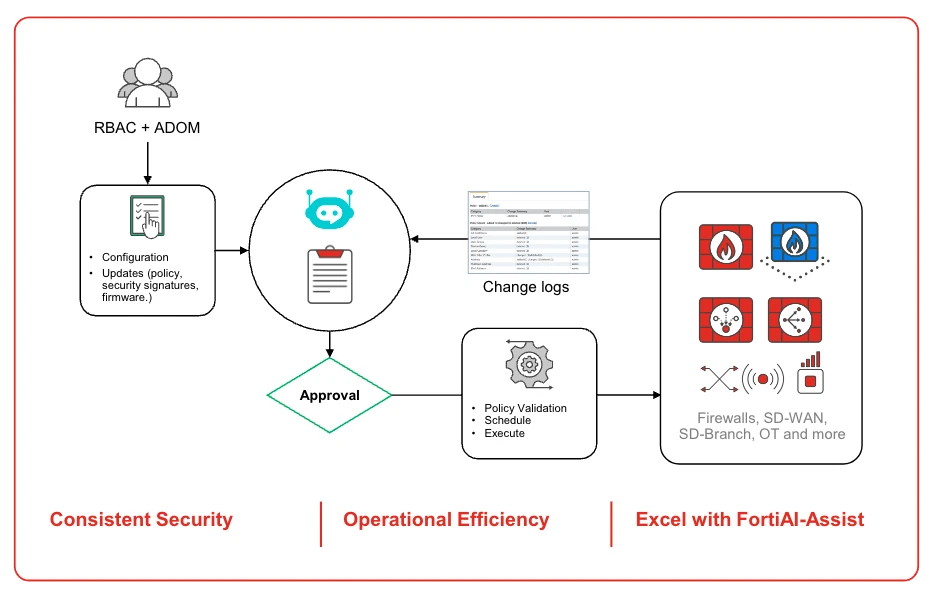
Past a certain number of devices the risk stops being the firewall rules and starts being the change process. FortiManager puts configuration, policy and firmware behind role-based access, administrative domains and an approval step, with validation before a push and a change log after it — which is also what an auditor asks to see.
The whole platform, on one page
FortiGate and FortiGuard sit at the centre; everything else is either managed by them or feeds them. Thin edge, data centre, campus and branch are the same architecture at four scales.
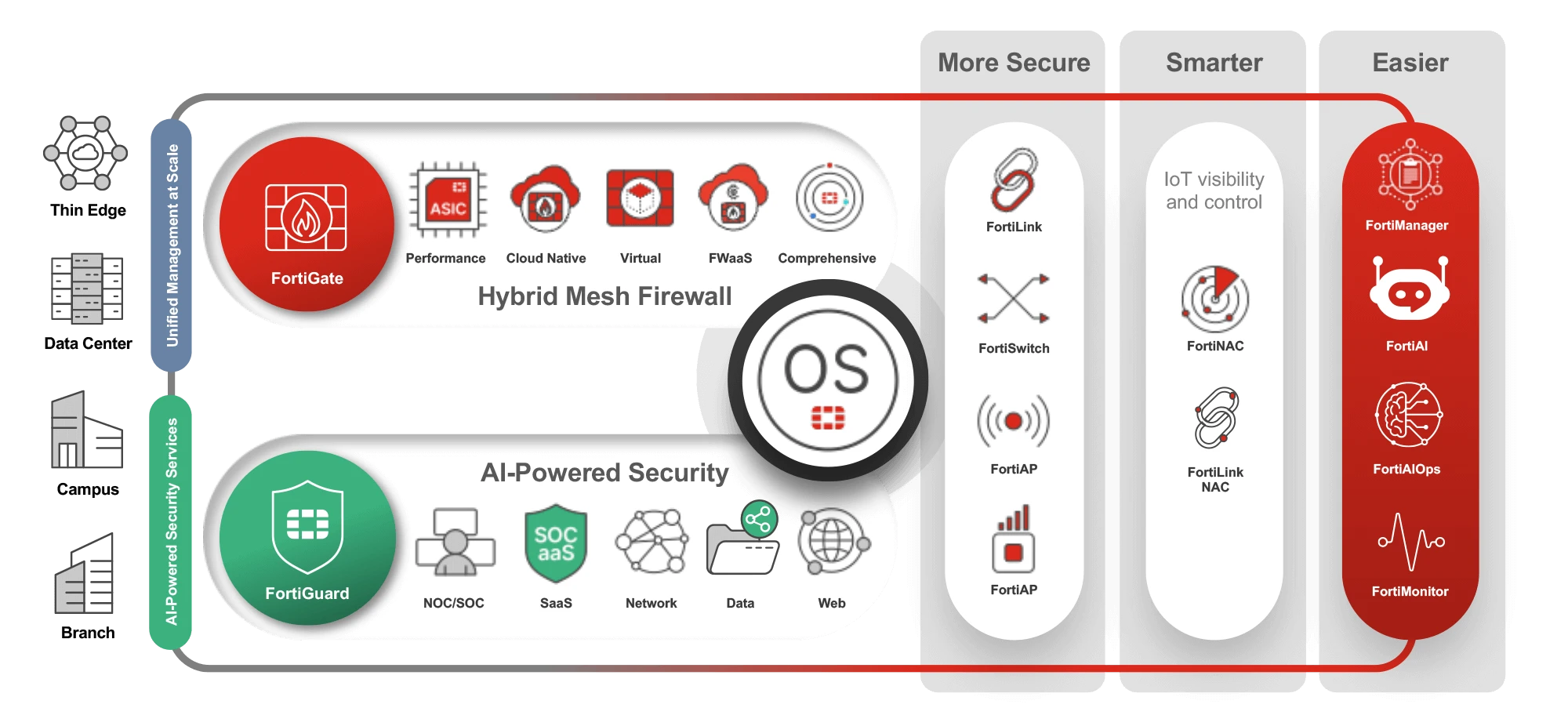
What you actually order
The architecture is made of these. We quote any combination of them, with the licensing and support that goes with each.
FortiGate
The firewall, and the controller for everything below it. Appliance, virtual machine, cloud-native or firewall-as-a-service — all running FortiOS.
FortiSwitch
Ethernet switching managed from the FortiGate over FortiLink, so a port is a policy object rather than a separate configuration.
FortiAP
Wi-Fi access points, including Wi-Fi 7, managed by the same FortiGate. No separate wireless controller to license or patch.
FortiExtender
5G and LTE gateways that present cellular as a managed WAN link under the same policy, for failover or for sites with no wireline option.
FortiManager
Central configuration, policy packages, templates and firmware for the whole estate, with role-based access and an approval workflow.
FortiAnalyzer
Log collection and reporting across every device in the fabric, including the security rating that scores how far the estate has drifted.
FortiGuard
The subscription services — IPS, antivirus, web filtering, DNS and botnet intelligence — that every enforcement point draws from.
FortiNAC
Device discovery, profiling and network access control, so an unmanaged device is identified and placed before it gets to anything.
What the analysts say
Fortinet was named a Leader in the 2026 Gartner Magic Quadrant for Hybrid Mesh Firewall, and placed highest in Ability to Execute for the second consecutive year.
Gartner, Magic Quadrant for Hybrid Mesh Firewall, Rajpreet Kaur, Adam Hils, Odie Adesina, 7 September 2026.
GARTNER is a registered trademark and service mark of Gartner, Inc. and/or its affiliates in the U.S. and internationally, and MAGIC QUADRANT is a registered trademark of Gartner, Inc. and/or its affiliates, and are used herein with permission. All rights reserved. Gartner does not endorse any vendor, product or service depicted in its research publications, and does not advise technology users to select only those vendors with the highest ratings or other designation. Gartner research publications consist of the opinions of Gartner's research organization and should not be construed as statements of fact. Gartner disclaims all warranties, expressed or implied, with respect to this research, including any warranties of merchantability or fitness for a particular purpose.
A Forrester Total Economic Impact study of Fortinet Secure LAN Edge reported 308% ROI and 9.9 million US dollars net present value over three years, with payback inside six months.
Read it for the shape of the argument rather than the number. The study was commissioned by Fortinet, and the figures describe one composite organisation — a three-billion-dollar global company — modelled from four customer interviews, not an average across customers. Your own numbers will turn on how much duplicated tooling you are retiring.
Forrester Consulting, The Total Economic Impact of Fortinet Secure LAN Edge, commissioned by Fortinet, June 2025.
Common questions
What is Fortinet secure networking?
It is Fortinet's term for running networking and security as one system instead of two. A FortiGate firewall running FortiOS also manages the FortiSwitch switches, FortiAP access points and FortiExtender gateways behind it, so switch ports, SSIDs and WAN links are objects in the firewall policy rather than separate configurations in separate consoles.
Do I have to replace my switches and access points to use a FortiGate?
No. A FortiGate works as a firewall in front of any vendor's network equipment. Converging is what adds the management benefit, and most estates get there over several refresh cycles rather than in one purchase — the firewall first, then switching and Wi-Fi as the existing kit ages out.
What is FortiLink?
FortiLink is the protocol a FortiGate uses to manage FortiSwitch and FortiAP devices directly. It is what removes the separate switch and wireless controllers: the access layer is configured from the firewall, and the firewall already knows what policy applies.
How is this different from a hybrid mesh firewall?
They answer different questions. A hybrid mesh firewall is about one policy across many enforcement points — data centre, branch, cloud, as-a-service. Secure networking is about depth at one site: pulling the switching and Wi-Fi underneath the firewall. Most estates end up doing both, and both are managed from the same FortiManager.
Is it worth it for a small network?
Below roughly a dozen devices on one site, honestly, the saving is modest — a FortiGate with third-party switching works fine. The case gets strong with multiple sites, with a small team running the network as part of a wider job, or where an audit is going to ask who changed what and when.
Does Grizzly X supply and support this in Canada?
Yes. We are a Canadian Fortinet reseller — FortiGate appliances and virtual licences, FortiSwitch, FortiAP, FortiExtender, FortiManager, FortiAnalyzer and the FortiGuard subscriptions. Coverage varies by province, so tell us where the sites are along with the port counts and throughput, and we will confirm what we can deliver and quote it.
Converging a network?
Send us the sites, the port and access point counts, and what the WAN looks like at each one. We will come back with the FortiGate models, the switching and Wi-Fi to go under them, and the licensing — including what we would phase rather than buy at once.
Request a Quote