
FortiGate 3000G
90 Gbps of IPS, 88 million concurrent sessions and six 100 GE QSFP28 slots, with FortiSentry watching the firmware.
Full specs and SKUsFortinet · FortiGate High-End
Of the 57 specifications Fortinet publishes across these two models, 29 differ. The differences are listed first, then what the step up actually buys and which model fits which site, then every row side by side.
90 Gbps of IPS, 88 million concurrent sessions and six 100 GE QSFP28 slots, with FortiSentry watching the firmware.
Full specs and SKUs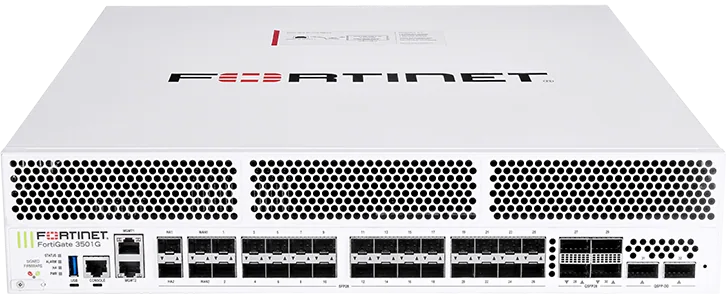
125 Gbps of IPS, 179 million concurrent sessions and two 400 GE QSFP-DD ports in 2 RU.
Full specs and SKUsThe rows most buyers check first. All 29 differences are in the full table below.
IPS Throughput
FortiGate 3000G90 Gbps
FortiGate 3500G125 Gbps
NGFW Throughput
FortiGate 3000G85 Gbps
FortiGate 3500G115 Gbps
Threat Protection Throughput
FortiGate 3000G80 Gbps
FortiGate 3500G105 Gbps
IPv4 Firewall Throughput (1518 / 512 / 64 byte, UDP)
FortiGate 3000G397 / 394 / 234 Gbps
FortiGate 3500G595 / 590 / 420 Gbps
IPv6 Firewall Throughput (1518 / 512 / 86 byte, UDP)
FortiGate 3000G397 / 394 / 234 Gbps
FortiGate 3500G595 / 590 / 420 Gbps
Firewall Latency (64 byte, UDP)
FortiGate 3000G3.7 µs
FortiGate 3500G2.96 µs
Stepping up from the FortiGate 3000G to the FortiGate 3500G moves threat-protection throughput from 80 Gbps to 105 Gbps (+31%), IPS throughput from 90 Gbps to 125 Gbps (+39%) and NGFW throughput from 85 Gbps to 115 Gbps (+35%). Neither choice moves the session setup rate (1.1 Million / 3 Million with the hyperscale licence against 1.1 Million) or SSL-VPN throughput (9 Gbps against 9.8 Gbps), so a site held back by bursts of short-lived connections gains nothing from the FG-3500G. The FortiGate 3000G is in fact ahead on power draw: 550 W / 808 W against 678 W / 973 W.
28 of the 57 published rows are identical — Trusted Platform Module at Yes, Concurrent SSL-VPN Users at 30,000, Virtual Domains at 10 / 500 and Maximum Number of FortiAPs at 4,096 / 2,048 among them — so the choice does not touch any of those.
Every published row for both models, grouped the way Fortinet groups them. A dash means the figure is not published for that model.
| Specification | FortiGate 3000G | FortiGate 3500G |
|---|---|---|
| Interfaces and Modules | ||
| Hardware Accelerated 100 GE QSFP28 / 40 GE QSFP+ Slots | 6 | 4 |
| Hardware Accelerated 25 GE SFP28 / 10 GE SFP+ / GE SFP Slots | 16 | 30 |
| Hardware Accelerated 10 GE / 5 GE / 2.5 GE / GE RJ45 Ports | 16 (including 2 x WAN ports) | Not published |
| 10 GE / GE RJ45 Management Ports | 2 | 2 |
| Hardware Accelerated 400 GE QSFP-DD / 200 GE QSFP56 / 100 GE QSFP28 / 40 GE QSFP+ Ports | Not published | 2 |
| USB Ports (Client / Server) | Not published | 1 |
| Hardware | ||
| USB Ports | 1 | Not published |
| Console Port (RJ45) | 1 | 1 |
| Trusted Platform Module (TPM) | Yes | Yes |
| Signed Firmware Hardware Switch | Yes | Yes |
| FortiSentry | Yes | Yes |
| Included Transceivers | 2 x SFP+ (SR 10 GE) | 2 x SFP+ (SR 10 GE) |
| Onboard Storage | None | None |
| System Performance - Enterprise Traffic Mix | ||
| IPS Throughput | 90 Gbps | 125 Gbps |
| NGFW Throughput | 85 Gbps | 115 Gbps |
| Threat Protection Throughput | 80 Gbps | 105 Gbps |
| System Performance and Capacity | ||
| IPv4 Firewall Throughput (1518 / 512 / 64 byte, UDP) | 397 / 394 / 234 Gbps | 595 / 590 / 420 Gbps |
| IPv6 Firewall Throughput (1518 / 512 / 86 byte, UDP) | 397 / 394 / 234 Gbps | 595 / 590 / 420 Gbps |
| Firewall Latency (64 byte, UDP) | 3.7 µs | 2.96 µs |
| Firewall Throughput (Packet per Second) | 351 Mpps | 630 Mpps |
| New Sessions/Second (TCP) | 1.1 Million / 3 Million with the hyperscale licence | 1.1 Million |
| Concurrent SSL-VPN Users (Recommended Maximum, Tunnel Mode) | 30,000 | 30,000 |
| SSL Inspection Throughput (IPS, avg HTTPS) | 75 Gbps | 112 Gbps |
| SSL Inspection CPS (IPS, avg HTTPS) | 50,800 | 112,345 |
| SSL Inspection Concurrent Session (IPS, avg HTTPS) | 9.9 Million | 18 Million |
| Virtual Domains (Default / Maximum) | 10 / 500 | 10 / 500 |
| Maximum Number of FortiAPs (Total / Tunnel) | 4,096 / 2,048 | 4,096 / 2,048 |
| Maximum Number of FortiClients | 50,000 | 50,000 |
| System Performance | ||
| Concurrent Sessions (TCP) | 88 Million / 230 Million with the hyperscale licence | 179 Million |
| Firewall Policies | 200,000 | 200,000 |
| IPsec VPN Throughput (512 byte) | 105 Gbps | 163 Gbps |
| Gateway-to-Gateway IPsec VPN Tunnels | 40,000 | 40,000 |
| Client-to-Gateway IPsec VPN Tunnels | 200,000 | 200,000 |
| SSL-VPN Throughput | 9 Gbps | 9.8 Gbps |
| Application Control Throughput (HTTP 64K) | 159 Gbps | 197 Gbps |
| CAPWAP Throughput (HTTP 64K) | 148 Gbps | Not yet published by Fortinet |
| Maximum Number of FortiSwitches Supported | 300 | 300 |
| Maximum Number of FortiTokens | 20,000 | 20,000 |
| High Availability Configurations | Active-Active, Active-Passive, Clustering | Active-Active, Active-Passive, Clustering |
| Dimensions and Power | ||
| Height x Width x Length (mm) | 88.5 x 437 x 495.75 | 88.5 x 442.5 x 529.3 |
| Height x Width x Length (inches) | 3.48 x 17.20 x 19.52 | 3.5 x 17.4 x 20.8 |
| Form Factor (supports EIA/non-EIA standards) | Rack Mount, 2 RU | Rack Mount, 2 RU |
| AC Current (Maximum) | 12A@100V, 9A@240V | 12A@100V, 9A@240V |
| Power Consumption (Average / Maximum) | 550 W / 808 W | 678 W / 973 W |
| Dimensions | ||
| Weight | 33.73 lbs (15.3 kg) | 36.7 lbs (16.65 kg) |
| Power and Environment | ||
| AC Power Supply | 100-240V AC, 60-50 Hz | 100-240V AC, 60-50 Hz |
| Heat Dissipation | 2755 BTU/h | 3318 BTU/h |
| Redundant Power Supplies | Hot Swappable, 2+2 | Hot Swappable, default dual AC PSU for 1+1 redundancy |
| Power Supply Efficiency Rating | 80+ Platinum | 80+ Compliant |
| Noise Level | 70.4 dBA | 70.4 dBA |
| Operating Temperature | 32°F to 113°F (0°C to 45°C) | 32°F to 113°F (0°C to 45°C) |
| Storage Temperature | -31°F to 158°F (-35°C to 70°C) | -31°F to 158°F (-35°C to 70°C) |
| Humidity | 5% to 90% non-condensing | 5% to 90% non-condensing |
| Forced Airflow | Front to Back | Front to Back |
| Operating Altitude | Up to 10 000 ft (3048 m) | Up to 10 000 ft (3048 m) |
| Compliance and Certifications | ||
| Compliance | FCC Part 15 Class A, ISED, CE, VCCI, PSE, BSMI, ANATEL, UL/cUL | FCC Part 15 Class A, ISED, CE, VCCI, PSE, BSMI, ANATEL, UL/cUL |
| Certifications | USGv6/IPv6 | USGv6/IPv6 |
Each step of the FortiGate High-End ladder, set against the model above it.
Tell us the throughput, port count and inspection features you need. We will confirm the right model, licence term and lead time, then quote it.
Request a Quote